ON JOSEPH MCELROY’S “WOMEN AND MEN”
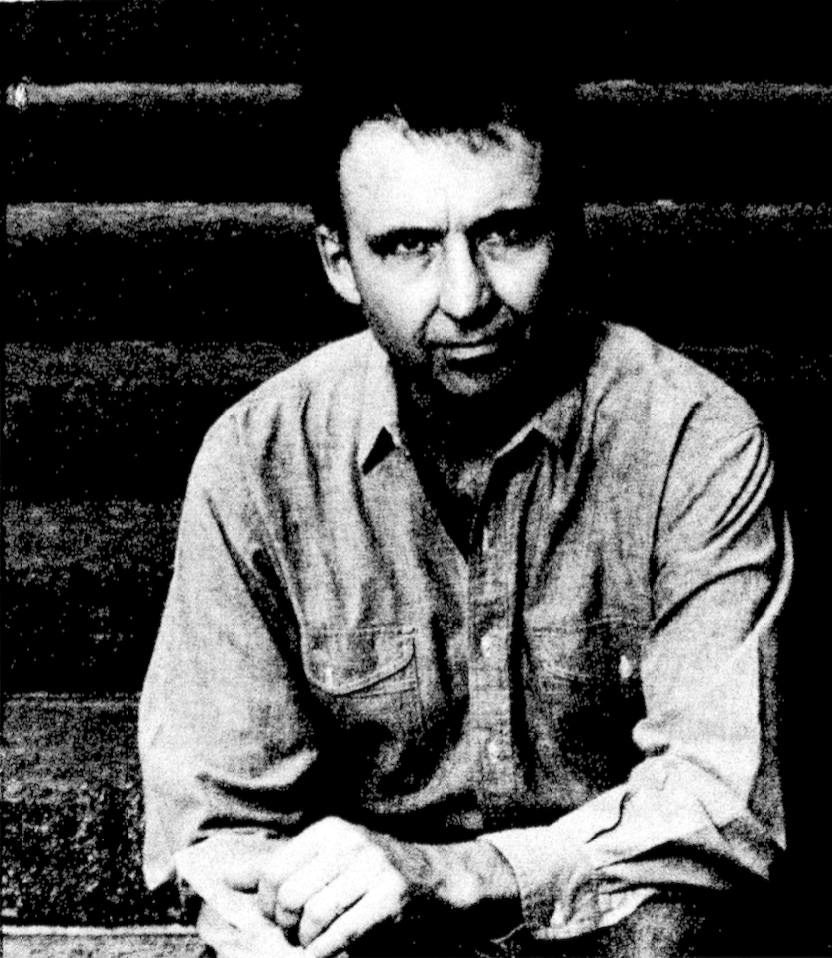
McElroy on the cover of the edition of the Review of Contemporary Fiction devoted to his work
I’m not quite sure what to say after finishing Joseph McElroy’s Women and Men for the second time. While preparation doesn’t feel like the right word, I did feel somehow more primed for the monolith this time around. Having said that, anyone who has read McElroy will know that any sturdy surface one might be inclined to cling to in the course of a narrative is summarily shaken, deeply and often.
When I first read the 1200 page tome, close to two years ago, there was a pervasive shock from the prose and the way the narrative unfolded, a shock so great that I’m frankly surprised I endured. But I’m more than glad that I did – this was a reading experience virtually unparalleled for me. In my first encounter with his fiction, McElroy’s sentences rearranged my neural networks and reoriented my synapses so thoroughly that the English language – something I had taken for granted – seemed foreign. I had tested my mettle against Joyce, Faulkner, Gaddis, Pynchon, DeLillo, Markson, Gass et al, but was desirous of something more. I wasn’t sure what that more was, or what form it would take, but I suspected it was out there. Reading McElroy to me was it. It was like encountering Evan Parker after years of listening to Coltrane: the connection with the forebears was evident, but it was certifiably its own thing: original, baffling, beautiful, inscrutable, vast; empowered and emboldened by its own internal logic. Once I took the plunge, as McElroy says in PLUS, it quickly dawned on me that, “the more that was all around was getting closer and closer.”
After my first reading of W&M, I made my way, with wide-eyed wonder, through the rest of his novels (save 2013’s Cannonball). His is a truly formidable corpus and it is a shame that more literary folks neglect him or aren’t even aware that he ever existed (his checkered publication history and the current outsized market for his books certainly don’t help matters there). McElroy’s interests throughout the eight novels of his that I’ve read are remarkably consistent and the diffuse narratives do seem aimed at a single target. In these books McElroy consistently turns over human experiences with memory; his native Brooklyn Heights and the city surrounding it, providing a roadmap for awareness of the individual within the aggregate; and how our inner lives interface and negotiate the outer world, the people we encounter, and our lived experience (the words inside and outside come up conspicuously and repeatedly in all of his books). To that end: In 2011, when McElroy was 81, he appeared for the second time on KCRW’s Bookworm show and claimed: “I think one reason for it – the health, the productivity and so forth, despite the age – has to do with this story. And I think it's that everyone whether a literal autobiographical fiction writer or not, and I am not I think, feels that as the years go on you're trying to get your story right, or you're trying to tell your story and each new attempt is different.” (emphasis mine)
McElroy writes ontological and epistemological noir – we become detectives of our own histories, and the lives we’ve lived. As he claimed in conversation Tom LeClair in 1978, McElroy says he writes, “psycho-philosophical mystery stories about the self putting itself back together again.”
//
Before I picked up W&M for the second time, and while reading his other works, I had been consistently haunted by its contents. I saw the seeds of its genesis in his preceding books: the relation of self and other, memory, enmeshed within a dense web of connection in A Smuggler’s Bible; detective stories and their relation to personal history in Hind’s Kidnap; the use of quantum field theory (and the double meaning of the word field) intertwined with quotidian, oft-repeated memories, and a parallel (“time outside of”) time in Ancient History: A Paraphase; the “oscillant continuity,” paranoia, epistemic uncertainty (“momentum and not clarity”) within Lookout Cartridge, which raises a network of unresolved perceptual issues; the nascent and growing consciousness with its growing glimmers of a life lived in PLUS; and falling, forbearance, and shock absorbed in W&M’s successor Actress in the House. All of those books impacted me deeply and with their own idiosyncrasies and charms, but they all seem to find their ultimate culmination and fulfillment in W&M.
W&M is one of those rare books that you realize you’re never finished with, and it with you. Although I knew I wanted to read it again – its level of detail almost demands a retrospective revaluation that only re-reading can bring – I never thought I would again have the time to reckon with it properly, life being what it is. Then again, I never anticipated the forced quarantine that we’re all collectively experiencing. So with the recognition that I couldn’t be in the city, I thought that bringing the city to me, and confronting this beast – something of the ultimate in “social distance” reading – seemed once again in order.
//
The novel is panoptic, far-reaching, all-encompassing, epic, frustrating, and real. In it, McElroy conjures a world of extended community: concentric circles of relations, angels, memories of things lived and half-remembered; 70’s New York City in such unbelievable vividness that you’d be tricked into thinking you’re there; post WW-II suburban New Jersey in all its suburban splendor (at one point literally diagramming the route between our hero, Jim Mayn’s, school, house, and grandparents’ house); various peregrinations through the American Southwest in the late 19th century, peppered with recondite historical figures like botanist Marcus Jones and the small-time revolutionary Jacob Coxey; a sweeping and consequential meditation on the sacred Navajo site Ship Rock near the “Four Corners” region in the American Southwest; a launch at Cape Kennedy; an emigre community of Chileans staging an opera of Hamlet; remembered visions of a piecemeal, not-yet-assembled Statue of Liberty. Women and Men is about messages we send, the distance between people, obstacles we face and navigate – like one of two subway doors opening, an image which recurs throughout – people who touch our lives in ways imperceptible to us, New York City, memory, void, community, family, relationships.
But that enumeration feels insufficient. Indeed, any attempt to write about a McElroy novel does come up short – plot summary is negligible and seems to miss the point, any particular occurrence occasions hundreds of other instantiations, details, asides; the profundity of the book seems ungraspable; the thicket of McElroy’s “endless community of minds” seems untangleable. Every time I’ve tried to lasso my scattered impressions after finishing one of McElroy’s books I’ve faced a similar difficulty of trying to penetrate what I think could be going on in his pages. Ironically I felt even less confident jotting down these impressions of W&M now than after my first read, even though (or maybe precisely because) I picked up on far more detail, and bore witness to more connections, this time than last. The level of simultaneity, where one senses that everything is going on at once, in various times and in various places, makes a linear analysis seem fruitless. To borrow from McElroy’s Ancient History: A Paraphase, the characters in W&M are “all time-warped centers of attractive force” (220, AH).
McElroy seemed to anticipate this difficulty of speaking about his work as early as his first novel, the auspicious debut A Smuggler’s Bible, wherein he claimed that: “In the age of explanation, a veritable chaos of elucidation is possible” (SB, 132). More poignantly, and again applicable to all of his later work: “I feel parentheses – or ‘curves,’ as they ought to be called – enclosing what I think and say. In some macabre way my own ingenuity and force have caused these parenthetical occlusions.” (SB, 325) When we begin to make an utterance about any instance in any of his novels, these “parenthetical occlusions” seem to be endemic and multiply left and right: “when he came right down to it, his thinking was mostly just a procession of separate parentheses” (SB, 37). To wit, McElroy’s colleague – and the reputable novelist in his own right – Harry Mathews said in his brilliant essay about W&M in the McElroy-devoted issue of Dalkey Archive’s Review of Contemporary Fiction that, “In W&M every what is turned into another what and eventually into every other what” (221) and goes on to say that Women and Men, “is an account of our reality as a one-ness multiplying into stupendous variety, variety dissolving into oneness. An account of our reality, no less recognizable for being altogether the author’s own.” (224)
Despite these multiplying “whats” and ever-generating obstacles – another word tossed around obsessively throughout W&M – I nevertheless feel an urge to try to grapple with certain aspects of the big book if only to try to unspool some of my thoughts on it and attempt to make sense of some of the 40 pages of compulsive notes I took this time around. I aim for succinctness but, “[aren’t] there more important things than being brief, Jim? If you’re still there. So Brief there is only everything to remember.” (702)
///
There’s a sense after reading this, particularly for a second time, that we’ve been through something together – that the individual has been folded into this community – and that “we met a point intrinsic for both of us” (739). This “we” and “us” keeps rearing its head throughout the course of the narrative, particularly in the so-called “breather” chapters – the long, digressive and speculative chapters, filled with some of the wildest prose in English – which are populated with angels, commenting on the events and in many cases revealing things, forging connections, shining a light on ambiguities, while we’re mired in their density. These angels are not distinct from us. They are us, and we are them. After the effort exerted while reading W&M, we are granted a membership in this league, we’re subsumed by them. They need us to be actualized, and mutually we need them for understanding the course of the fiction.
///
W&M begins in childbirth, a third person account of the mother’s perspective. Although upon closer inspection these opening pages seems more universalized, with McElroy presciently addressing the reader and encapsulating their potential experience with what’s to come: “After all she was not so sure what had happened, or when it had started. Which was probably not a correct state to be in because what had happened made the biggest difference in her life so far.” (3) McElroy goes on to subtly forecast a number of recurrent words and themes, words whose future significance couldn’t possibly be grasped by a first time reader. In another operative turn, looking towards his readers and forecasting a valid and likely experience with this future-torrent, McElroy says that “she didn’t so much recall it as hold onto its weight.” How else can a reader make sense of this book? For, like Jim Mayn, and the rest of the characters, who ceaselessly grapple with their memories and lived experiences – again, becoming “psycho-philosophic” detectives – we recall the weight, even though many of the particulars become hazy and half-digested, irrespective of the effort put in towards grasping them. There are aspects gleaned, but sometimes it feels like we, “understood only brief separate things, like beginning nowhere” (1138).
Mayn is a science reporter and a middle-aged divorcee who, after a long absence, returns to the Murray Hill apartment where he had raised his two children. Throughout the narrative Mayn is insistent that he never dreams, and is consistently turning over thoughts about his NJ grandmother Margaret and the stories she told him of her scandalous journey west, ostensibly under the guise of her own reportage of the World’s Fair and beyond. Yet “when he bothered to think about it, he wasn’t sure what he recalled and what inferred,” and according to his grandfather, Jim “sometimes added to what he was told” (842), which immediately problematizes our relationship with what he’s telling us, or the “known bits” that are being imparted to us. Indeed, “there’s so many ways by 1977 that if you don’t feel you’re in the worming tape tunnel ‘stead of it in you, you got to feel that it opens outward like a lip growing and rolling from every moist glim of its circum, and you are it and might’s well look back down the narrowing wind-tunnel as when you could—we all could—indulge in the uncontrolled controllability of nostalgia’s splicing and slimming of events to recombine or reconstitute them, as in "constitution" at some later libration point” (607).
This Midtown-East apartment building is the primary place of action, the center upon which all else orbits. It is there that Jim comes into contact with most of the minds who come to populate this city with (and within) him. The apartment building, like the novel, is a “multiple-dwelling, able to accommodate a multiplicity of small scale units.” Notably it is there where the principal woman figure, Grace Kimball, lives and conducts her Second-Wave feminist “Body-Self Workshops.” (More on her and her place in the novel to come, but a brief aside: Kimball and her workshops are, not particularly imaginatively, based on 70s feminist guru Betty Dodson and her “Bodysex” workshops)
After Mayn returns to Murray Hill, he spends his time reorienting himself in this apartment laden with memories of his past, he also is certain that he’s in the future looking back, and is haunted by “memories of the future” (52). Yet these claims that he’s in the future aren’t the ravings of a lunatic, since the breathers assure us that they are “literal but also because it is so private as to be imaginary” (42). He simply “lived in the future which came often enough” (987). Mayn is “thrust back along the particles of his own shadow to that future he came from where on metal plates persons two by two are being transferred by frequency to space settlements where upon arrival they will find themselves participating in a population-control project which Mayn knew of in advance” (88). This vision (or future memory) of Mayn’s motivates the whole book and he can’t “rid himself of the future whose shadow he carries” (74). As he tells his girlfriend Jean, “[he’s] in the future doubling back upon the past which is our present to see it and us so plausibly that it exists” (767).
Jim also consequentially becomes acquainted with Larry, a precocious teenager who lives down the hall, whose parents’ marriage has recently been torn asunder by the influence of Grace Kimball. Mayn, whose relationship with his own son is virtually non-existent, seems to adopt Larry and takes him to basketball games at Madison Square Garden, and lends an ear to his recently postulated theory of Obstacle Geometry which claims that “bending around the massive object yields the object itself” (379), which is also intertwined with – and “embraces” (975) his view of “Simultaneous Reincarnation” which we see in action throughout. OG also accommodates his derivation of PEOPLE MATTER (351, 354). Mayn learns of all of this through Larry, and sees the validity of his young friend’s assertions everywhere.
//
An essential and overarching aspect of McElroy’s new cosmology – evidently multi-pronged and dense – presents the reader with a new way of thinking about the almost-overwhelmingly detailed narrative that we find ourselves steeped in: delivered in full in a cosmic near-hundred-page “letter” – “not mainly by word-unit or real-page but as I do, including voice-over and memory-merge and the twin-scopes to come” (693) – by an inmate Foley (“a dreamer and a scientist” (982)) more than halfway through the narrative, wherein we learn about The Colloidal Unconscious. A colloid – where particles are both suspension and solution – is used as a metaphor for the “endless community of minds” (690) that McElroy presents to us. We see the suspended “mind-particles” of all of the dramatis personae, and see them communicate colloidally “where contact works through schism” (697), and McElroy shows us that it is, “The Way, The Way that swirls colloid in all of us” (691). Despite this being somewhat of a far-fetched theory, the novel’s structure – “all part of an orbital merry-go-round” (747) moving front, back, side-to-side, hopscotching time-zones and tense, person – plays it out convincingly, so much so that it assuages any potential doubt a reader might have about its existence, and makes it as “vivid as fact in suspension” (632).
While much more could be explicated about its ramifications, Foley cuts to the essential point of the image, and a crucial way of understanding the book by saying: “and while the colloidal particles with billions of unseeable faces and more all the time if we could only economize and move at random unless you commence the centrifugal, which is only in emergency unless you can make yourself either do it unconscious or find the neighborhood of messages that’s meant for you and for you to grain in on ‘cause it’s impossible not to give when you receive, you might lend your ears but there’s no lending there’s only giving, and you better live with your particles so you know how to work with them and their feeling for all other particles and so send what you want to send and only to whom it may concern” (743, emphasis added)
///
A brief digression about New York City, which “really was like this, with people running into each other and then talking without any actual reason to begin with” (1088).
I’ll start by asserting that few have written with such fondness and beauty about NYC than McElroy. Certainly not about Brooklyn Heights, his childhood home. His books have both reminded me of all that I love so deeply about my city, but also given insight into things that I couldn’t have voiced. “New York was a break you joined yourself across so oppositely to its noisy ways that it burst into silence like terrific photographs.” (135) Gaddis– with his ear that is, admittedly much stronger and more finely attuned than McElroy’s – ensconced us in a Manhattan full of talk and dialogue in JR that is peerless, but W&M brings out the real feeling of being a citizen of the city.
Early in Orson Welles’ The Lady From Shanghai, Welles’ character Michael O’Hara claims that, “New York is not as big as it pretends to be.” Women and Men certainly plays that out. Even if the only NYC we were presented with in the narrative were of Foley’s memories, we would be lucky. Foley notably has a breathless 2.5 page sentence account of a walk down an avenue near Union Square, naming a number of shops, stopping only to ask the perennial NYC question “still there?” He precedes this by stating to Mayn: “I found NY to be very big and very small at that moment, Jim, you’ve said the same thing observing that in your memory the city was neighborhood enough”
And while we’re at it, I’ll insert one of my favorite lines in McElroy’s oeuvre, from A Smuggler’s Bible: “David, dear, some blue evenings just before twilight, the skyline looks as if it had been constructed, not as a sequence of functional buildings or even (as that writer put it who did umpty-thousand words on the Heights for Vogue) as a giant cameo finely silhouetted on a rosy ground - but as memory – yes constructed as memory.” (SB 386)
“The City thinks for you”
///
“Wait a sec, there was a connection!” (851)
TW = TRACE WINDOW = TURNSTEIN/WING = TAPEWORM
SR = SIMULTANEOUS REINCARNATION = SHIP ROCK
PM = PEOPLE MATTER = PEARL MYLES
Windrow, Jim and Margaret’s fake name for Maplewood, NJ, derived from the windrose which Jim draws for his ex wife Joy.
///
Given that I’ve only praised W&M and McElroy to the heavens, it’s worth mentioning the less-than-exemplary aspects of the book – what would by today’s standards be judged “problematic.” It seems that the novel’s title is a bit misleading, given how much short shrift our central female character, Grace Kimball, is given. There is no dispute that Mayn is the Main concern. Indeed GK’s Body-Self Workshops – and by extension 2nd Wave feminism – are often derided and somewhat ridiculed. McElroy has since admitted this candidly in the relatively recent Paris Review piece: “I don’t think I could have written that big book if I hadn’t felt threatened. Terrible anger at some of the women I knew who were in organizations like what is written about in Women and Men.” This anger does come across, and is played out throughout the narrative. Having said that, there are remarkably consequential and deeply human aspects to Grace’s character, despite her caricature. And additional female characters (Margaret, Flick, Mayga) are not the butt of the joke whatsoever, and are crucial aspects of Mayn’s considerations and the novel as a whole.
It’s worth mentioning that Grace is also meant to be seen as another aspect of Jim’s character (and vice versa) and that they contain each other, despite never meeting. Grace has numerous dreams (something Mayn never does), and yet shares and “open sense of reincarnation” (109), and a similarly expansive visions of the future: “Grace saw ahead into a future that looked back at her through the same eye with which she saw it” (13).
///
“It was as if suddenly looking into the revealed distance we could think” (1161)
I realize I have only barely scratched the surface of all of this and disjointedly! I haven’t begun to touch on so many seminal aspects of the book which have occupied me deeply: Trace Windows; the Diva and her tapeworm; the Hermit Inventor of New York and his newly formulated weather (the extent of that which remains largely unclear although I have some intimations the more I think about it); the image of “The Wide Load” which the narrative is supposed to mirror; the structural insanity of the novel and what the three “types” of chapters do for the experience of the reader; the Chilean economist McKenna and his role in things; the network of private messenger services helmed by the endearing Jimmy Banks in his three “known bits” chapters; numerous notes I’d taken on Spence, an interloping, ubiquitous, “sleazy,” photo-journalist who may likely be Mayn’s brother; the suicide of Sarah Mayn, its significance, and who is buried in her grave; what is going on with the Anasazi Healer and his dispersion (reincarnation?) into a noctilucent cloud; the genealogy of the Mayn family revolver; and on and on and on and….
I suppose, then, that I’ve spilled much ink over nothing. But I will conclude by saying that Women and Men changed my life, on both reads, and in different ways. Almost no book has so shaken my outlook on human connection and what it means to live with our memories, and forge ahead. No novel has come close to the level of paradoxical density and clarity as this. Nobody has ever written English the way Joe McElroy does. If a copy is available, seek it out. It is worth the effort. It is world-making.
“It came to them together that they each were coming full circle, if that was ever possible” (1086).